

Includ-ED: Strategies for inclusion and social cohesion from education in Europe is an Integrated Project of the priority 7, 6th Framework Programme of the European Commission. Integrated Projects integrate together the critical mass of activities and resources needed to achieve ambitious clearly defined scientific objectives structuring effect on the fabric of European research. Includ-ED was the only project focused on compulsory education which was selected in the last Calls for Proposals of the 6th Framework Programme.
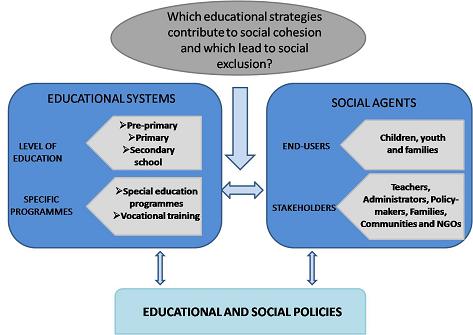
Includ-ED is focused on the study of the interactions between educational systems, agents and policies, up to the compulsory level (i.e. pre-primary, primary, and secondary education, including vocational and special education programmes), as reflected in the following diagram:
Projects:
To this end, Includ-ED ask the following research questions:
• Which school systems and educational reforms have generated high rates of school failure and which ones generated low rates? (PROJECT 1)
• Which educational practices (at the level of system, school and classroom) increase school failure and which ones lead to school success? (PROJECT 2)
• How does educational inclusion/exclusion impact inclusion/exclusion from diverse areas of society such as employment, housing, health and political participation? (PROJECT 3)
• How is educational inclusion/exclusion affecting most vulnerable social groups, particularly women, youth, migrants, cultural groups, and people with disabilities? (PROJECT 4)
• Which mixed interventions between education and other areas of social policy contribute to overcome exclusion and foster social cohesion in Europe? (PROJECT 5)
• How does community involvement in education contribute to strengthen connections between education and diverse areas of society? How do these mixed interventions contribute to social cohesion? (PROJECT 6)
Methodology:
Includ-ED, through the critical communicative research perspective aims at having a significantsocial and political impact on the European educational and social systems. The critical communicative perspective arises from different theoretical contributions. The bases of the Critical Communicative Methodology are:
1. Knowledge Constructed Through Intersubjective Dialogue
Meanings are constructed in interactive communication between people, reaching agreements. The researchers bring their expertise and the recent developments in the scientific community into the dialogue and this is contrasted with what social actors think and experience in their everyday lives.
The critical communicative methodology assumes a series of postulates:
• universality of language and action
• people as transformative social agents
• communicative rationality, disappearance of the interpretative hierarchy
• dialogic knowledge.
The researcher and the social agents share their knowledge in order to identify the strategies that overcome the exclusionary elements. This methodology requires to create the conditions that enable intersubjective dialogue between participants through an egalitarian relationship.
2. Including Traditionally Silenced Voices
There is a direct and active participation of the people whose reality is studied throughout the entire research process.
The analysis of educational strategies that contribute to social cohesion and educational strategies that lead to social exclusion requires theinclusion of the maximum diversity of voices (i.e. all related stakeholders and end-users) and to draw from a wide range of sources. While the voices of vulnerable groups have been traditionally excluded from research, the critical communicative methodology relies on the direct and active participation of the people whose reality is being studied throughout the whole research process.
As for example, with the communicative methodology, vulnerable groups have seen the possibility to participate in a research that takes their voices into account in order to contribute to overcome their social exclusion. Includ-ED count on the participation of representatives from collectives of immigrants, people with disabilities, women, youth (at risk) and Romà, in the research through the Advisory Committee.
Several mechanisms have been foreseen to preserve the project's ethical integrity and protect the study participants' from any kind of misuse of the collected data about them.
3. Exclusionary and Transformative Components
Scientific analysis oriented towards identifying strategies that lead to social inclusion (transformative) and those which lead to social exclusion (exclusionary).
The communicative data analysis helps to disclose the complexity of reality and to avoid simplistic explanations that categorise a dimension as entirely exclusionary or transformative. One of the most important objectives of communicative research is tofocus on analysing inequalities and to contribute to solutions through dialogue among all agents involved. The exclusionary and transformative axis will facilitate the analysis of the educational strategies that contribute to social cohesion and those that deter it.
The critical communicative methodology provides the possibility to integrate and incorporate different disciplines and orientations, using distinct methods and techniques to collect and analyse data, that is to say, applying mixed methods (quantitative and qualitative). The different methods have been chosen according to research operational objectives but the communicative orientation will be held throughout the project.
Different research techniques:
| Data Collection Techniques | Data Analysis Techniques | |
| QUANTITATIVE | Questionnaire | Statistical analysis |
| Secondary analysis of existing datasets (e.g. OECD, EUROSTAT, UNESCO, PISA, PIRLS, TIMSS) | ||
| QUALITATIVE | Literature review (e.g. ERIC, SOCIOFILE, JSTORE, ACADEMIC PREMIERE SEARCH) | |
| Policy Analysis (e.g. Directives, policies, EURYDICE, LEXIS-NEXIS) | ||
| Document | Content analysis | |
| Standardized open-ended interviews | Communicative data analysis (exclusionary and transformative dimensions) | |
| COMMUNICATIVE | Communicative daily life stories | |
| Communicative focus groups | ||
| Communicative observations | ||


